Are you using AI for field hockey coaching?
I think you should.
Not a fan of AI for field hockey yet? If you’re only experience so far has been some disappointing answers from ChatGPT or the other well known generic AI platforms out there, I get you might have some doubts.
In that case I’ve got a double solution for you !
- Assistant.Hockey : all answers are grounded in the expertise from some of the best field hockey coaching minds in the world… and we share the sources where we got the answer from.
- TheHockeySite.app : our answers not only come from the same experts but it also knows you, your thoughts on the game, your team, your players, your circumstances.
Make sure you get that edge. AI is already changing the way we work. Make sure you don’t miss the boat, because the wind is picking up
Assistant.Hockey knows field hockey
Assistant.Hockey answers coaching questions about field hockey and nothing else. It does not go looking on the internet at all. Every answer comes from the masterclasses, workshops and panel talks recorded with The Hockey Site over the years, and it tells you which coach and which session it came from, so you can go and watch the thing yourself rather than take it on faith.
Ask it about coaching principles, tactical choices, technical skills, mental coaching, strength and conditioning, injury prevention, or how to organise a session. Ask it to argue with a plan you have already written. It is better at that than most coaches expect.
TheHockeySite.app knows you as well
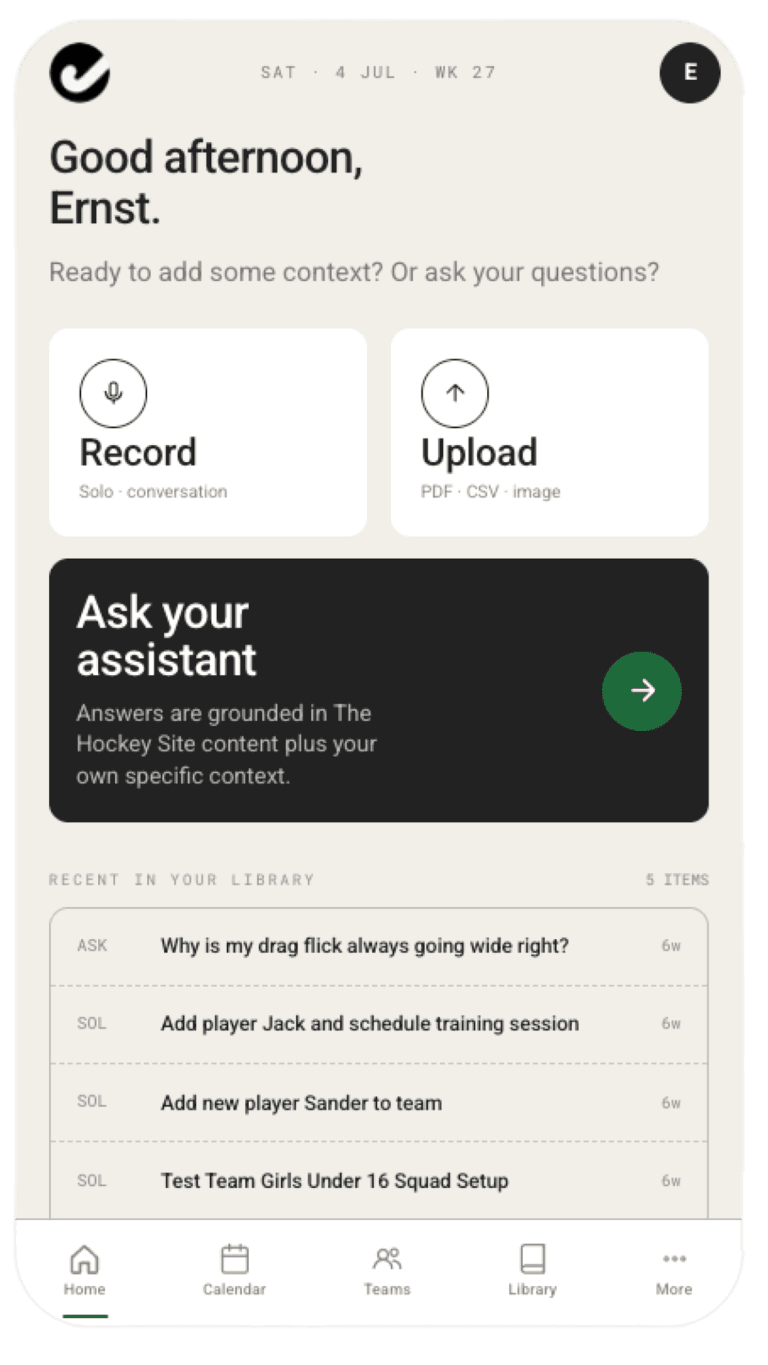
A simple app with just 3 buttons. Record, Upload, Ask.
Record
Talk to it. Walking back to the car after training, say what happened, who looked sharp, what you want to fix on Thursday. It transcribes it and files it. There is a conversation mode as well that handles more than one voice and works out who said what, for staff meetings and player conversations. Type it instead if you would rather.
Upload
Drop in what you already have. PDFs, spreadsheets, a screenshot of your dashboard after video analysis, a photo of the whiteboard, an exported chat from your team group. Add your thoughts to these using a quick voice note.
Ask
Then ask. Ask it anything. Answers come from two places and it always tells you which: the coaching experts, with a link straight through to the masterclass behind the answer, and your own thoughts and data, with a link to your own note. If neither covers it, it says so. It will not invent something off the internet, because it cannot reach the internet.
Just 3 buttons
Add your teams, your players, your calendar with games and practice sessions. It links all you share to them. It links a new note to the right player or session on its own and shows you why it did, so you can correct it when it guesses wrong. Sync your standard calendar. Invite a co-coach and share a team with them.
It works in English, Dutch, French, German and Spanish. It is built for your phone: add it to your home screen, there is nothing to install. We keep it simple, yet powerful.
What it will not do
Worth saying plainly, because the gap between what a tool claims and what it actually does is where trust goes to die.
- No video. Files only: PDF, CSV, TXT, MD, JPG, PNG.
- No internet answers. If it is not in our masterclasses or in your own workspace, you get “I do not know” rather than a guess.
- No drill library. It is not a place to copy session plans from. That is deliberate. We want you to think instead of using copy/paste.
- Mobile first. It’s made for a phone. Laptop works as well.
- It replaces nothing you already use. If your video analysis, your planning tool and your notebook are working for you, keep them.
Access only for our Pro Coach subscribers…
How to ask a better question
Using AI is different from asking Google to look for something. The biggest difference between a useless answer and a good one is the question. That’s true for our AI solutions as well as the generic ones.
Four things to put in your question.
Who. Your team, their level, their age. “My U16 girls, club level, second season together” changes everything about the answer.
What. The actual problem, specifically. Not “how do I improve my press” but “we lose the ball on the left when the opposition switch, and both my forwards keep chasing it”.
How. The constraints. Forty minutes, half a pitch, twelve players, no keeper.
Output. What you want back. A drill, three questions to ask the team, or a critique of the plan you have already written.
Then follow up. The second and third questions are where the useful part lives. Treat it like a conversation with an assistant coach, not a search box.